


Renovation budgets don’t usually blow out because people are careless.
They blow out because what feels like careful planning often isn’t aligned with how renovations actually behave.
Many homeowners do everything they think they should:
- They research
- They get quotes
- They set a budget
- They try to be realistic
And still, costs creep higher than expected.
This article explains why renovation budgets blow out, even with good intentions—and how to plan in a way that reduces surprises without needing perfect information.
Why Renovation Budget Anxiety Is So Common
Budget stress isn’t just about money.
It’s about:
- Uncertainty
- Loss of control
- Fear of making irreversible mistakes
Unlike most purchases, renovation costs:
- Are estimates, not fixed prices
- Depend on decisions made over time
- Are affected by hidden conditions
This makes budgeting for a renovation fundamentally different from budgeting for almost anything else.
The Hidden Reason Most Renovation Budgets Fail

The biggest misconception in home renovation planning is this:
“If I’ve done enough research, the budget should be accurate.”
In reality, budgets fail because they’re built on assumptions that haven’t been tested yet.
Renovation budgets aren’t wrong—they’re incomplete.
The Most Common Reasons Renovation Budgets Blow Out
1. Early Budgets Are Based on Incomplete Decisions
At the start of a renovation, many key decisions are still unknown:
- Final layouts
- Service locations
- Material selections
- Construction constraints

Early budgets often assume “average” solutions.
As decisions become real, costs become specific—and specificity almost always costs more than averages.
The real issue:
The budget didn’t evolve as decisions became clearer.
2. Quotes Reflect Scope—Not Intentions
Quotes are only as accurate as the information behind them.
When scope is unclear, quotes may:
- Exclude items that seem “obvious” to the homeowner
- Assume lower-cost solutions
- Leave room for variation later
This isn’t dishonesty—it’s how quoting works.
The real issue:
Pricing happened before the scope was truly defined.
3. Small Upgrades Compound Quickly

A slightly better tile.
A nicer tap.
A more durable surface.
Each upgrade feels manageable on its own.
But renovations multiply decisions:
- A premium finish may require better preparation
- Better preparation increases labor.
- Labour increases timeline and cost
Budgets don’t blow out because of one big decision—they blow out because of many small ones stacking together.
4. Existing Homes Always Hide Something
Unlike new builds, renovations involve unknown conditions.

Common surprises include:
- Old wiring or plumbing
- Structural changes from past work
- Non-compliant elements
- Hidden water damage
These aren’t mistakes—they’re realities of working with existing buildings.
The real issue:
No allowance was made for the unknown.
5. Timelines Affect Costs More Than People Expect
Time and money are linked.
Delays can:
- Increase labour costs
- Extend site overheads
- Trigger storage or accommodation expenses
When timelines slip, budgets often follow—even if nothing “extra” was added.

Why “Contingency” Is Often Misunderstood
Many homeowners include a contingency—but don’t fully understand its purpose.
Contingency isn’t for:
- Poor planning
- Indecision
- Last-minute upgrades
It’s for:
- Unknown conditions
- Necessary changes
- Things that couldn’t reasonably be known earlier
When contingency is treated as optional, budget stress increases dramatically.
A Better Way to Think About Renovation Budgeting

Instead of asking:
“How much will this renovation cost?”
A more useful question is:
“What decisions are still unknown, and how might they affect cost?”
Practical budgeting means:
- Expecting change
- Updating numbers as decisions firm up
- Understanding where flexibility exists
This keeps you in control—even when costs move.
How Good Planning Reduces Budget Blowouts

Good home renovation planning doesn’t eliminate surprises. It:
- Surfaces assumptions early
- Separates essential costs from optional upgrades
- Aligns scope, timing, and budget
- Helps homeowners make trade-offs deliberately
This is especially important for first-time home renovation projects, where expectations are still forming.
If Your Budget Is Already Under Pressure
If costs are rising and you feel unsettled, you’re not alone.

The most helpful step isn’t panic—it’s clarity.
Ask:
- What changed?
- Why did it change?
- Was this predictable earlier?
Understanding the cause restores control—even mid-project.
Budget Confidence Comes From Visibility, Not Certainty
No renovation budget is perfectly accurate.

But good budgets feel calmer because:
- Changes are expected
- Trade-offs are visible
- Decisions feel intentional
That confidence doesn’t come from luck—it comes from structure.
A Quiet Next Step (If This Sounds Familiar)

Over time, we noticed that renovation budgets rarely failed because of one big mistake—they failed because of small, compounding assumptions.
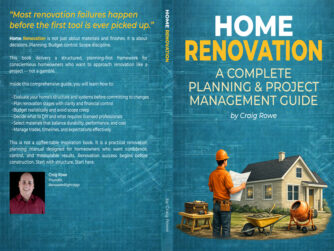
Turning those patterns into clear planning logic eventually became our book, Home Renovation, your complete planning and home renovation project management guide focused on understanding the anatomy of your home before planning your home renovation.
If this article helped reframe how you think about renovation budgeting, there are more renovation planning and budgeting topics, there’s more structure freely available on this site, or when you buy our book or by signing up to the RenovateRight.app whenever you’re ready.