One of the most common fears homeowners have is this:
“I don’t know enough to avoid making mistakes.”
It’s a reasonable concern—especially if this is your first time renovating.
But here’s the truth most people never hear: You don’t need to be a building expert to avoid renovation mistakes.
Most costly mistakes happen not because homeowners lack technical knowledge, but because they’re forced to make decisions without the right structure.
This article explains how to stay in control—even if you never learn the technical details.
Why Expertise Isn’t the Real Problem
Renovations feel intimidating because they involve:
Unfamiliar terminology
Permanent outcomes
Decisions that seem irreversible
So it’s easy to assume expertise is the solution.
In reality, many renovation mistakes occur despite expert involvement—because clarity and sequencing were missing.
Knowledge helps. Structure helps more.
The Renovation Mistakes That Expertise Alone Doesn’t Prevent
Even knowledgeable homeowners run into trouble when:
Decisions are rushed
Scope isn’t clearly defined
Assumptions go unchallenged
Changes happen too late
Technical understanding doesn’t automatically solve these issues.
They’re planning problems—not skill gaps.
What Actually Helps You Avoid Renovation Mistakes
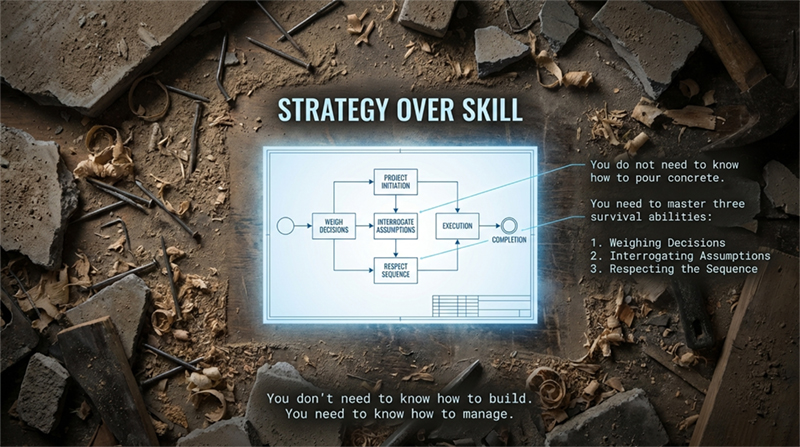
Instead of trying to “learn everything,” focus on three practical abilities.
1. Knowing What Decisions Matter Most
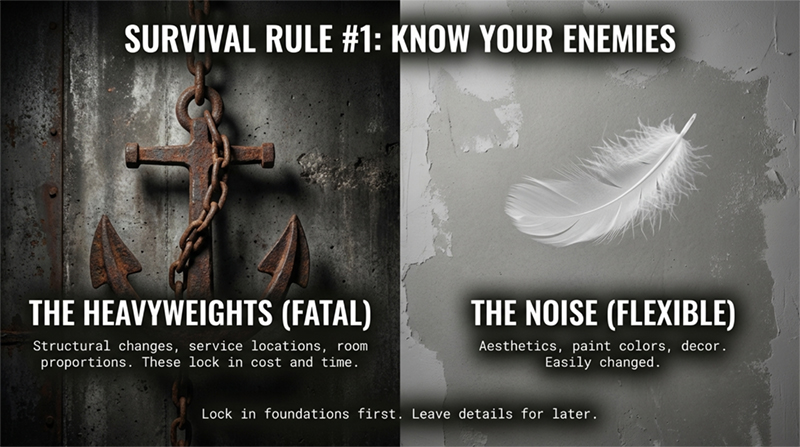
Not all decisions carry the same weight.
Some choices are easy to change. Others lock in cost, time, and complexity.
You don’t need to know how to build—you need to know which decisions deserve extra care.
Examples:
Structural changes
Service locations
Room proportions
Slowing down here prevents many common renovation mistakes.
2. Asking Better Questions (Not More Questions)
Avoiding mistakes isn’t about asking endless questions.
It’s about asking the right ones at the right time.
Helpful questions include:
“What assumptions are we making here?”
“What becomes harder if we change this later?”
“What else does this decision affect?”
These questions surface risks early—without requiring technical knowledge.
3. Understanding the Sequence of Work
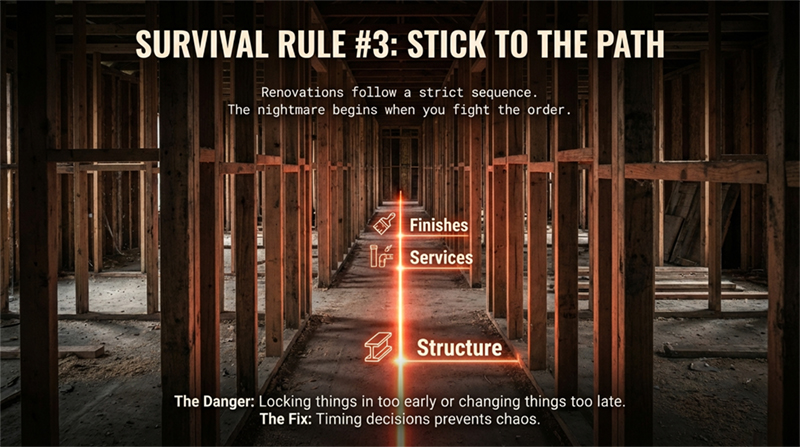
Renovations follow a sequence whether you understand it or not.
When homeowners don’t understand the order of decisions, they:
Lock things in too early
Change things too late
Feel constantly behind
Knowing the sequence helps you time decisions, which reduces mistakes dramatically.
Why First-Time Renovators Feel Especially Vulnerable
First-time home renovation projects often feel risky because:
Everything is new
Mistakes feel permanent
There’s no reference point
But first-time homeowners also have an advantage: They’re more likely to pause, question, and seek clarity.
With the right structure, that caution becomes strength.
A Simple Framework for Staying Out of Trouble
Here’s a practical way to think about your role as a homeowner:
You don’t need to know how to do the work. You need to know when to decide, when to ask, and when to pause.
If you can do that, you’re already ahead of many people.
Step 1: Separate Decisions From Information
Information is endless. Decisions are finite.
When overwhelmed, ask:
“What decision am I actually trying to make right now?”
This cuts through noise and reduces decision fatigue.
Step 2: Lock in Foundations, Not Details
Foundational decisions first. Details later.
This avoids the trap of overthinking things that can easily change—and underthinking things that can’t.
Step 3: Treat Changes as Signals, Not Failures
Wanting to change something doesn’t mean you planned poorly.
It often means new information has emerged.
The key is to recognize when changes are cheap — and when they’re expensive.
Why Good Planning Feels Like Confidence
When homeowners say they feel “out of their depth,” what they usually mean is:
Decisions feel rushed
Trade-offs feel unclear
Consequences feel invisible
Good planning doesn’t eliminate uncertainty—it makes it manageable.
That’s what confidence actually is.
If You’re Afraid of Getting It Wrong
That fear is understandable—and useful.
It means you care about outcomes.
Channel it into:
Slowing down key decisions
Clarifying assumptions
Understanding sequence
You don’t need expertise. You need perspective.
Renovation Success Isn’t About Control—It’s About Timing
The homeowners who avoid major renovation mistakes aren’t the most knowledgeable.
They’re the ones who:
Decide deliberately
Ask the right questions
Respect the order of decisions
That’s learnable—and achievable—without becoming a building expert.
A Quiet Next Step (If This Reassured You)
Over time, I noticed that homeowners didn’t need more technical detail—they needed confidence in their role.
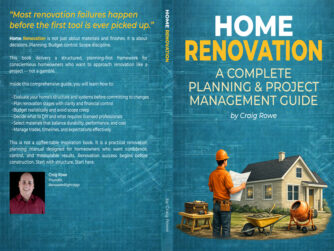
Clarifying that role eventually shaped our Home Renovation book: your complete planning and home renovation project management guide focused on understanding the anatomy of your home before planning your home renovation.
If this article helped reframe how you think about renovation budgeting, there are more renovation planning and budgeting topics, there’s more structure freely available on this site, or when you buy our book or by signing up to the RenovateRight.app whenever you’re ready.
There’s always more renovation advice available when you’re ready.
Most people think renovation starts when work begins. In reality, the most important part of a renovation happens before anything changes physically...