


Home renovation planning is where most projects either succeed—or quietly start to fail.

Not because homeowners are careless. Not because they didn’t research enough.
But because renovation planning is far harder than people expect, and almost no one explains why.
If you’re planning a renovation—especially if this is your first time—this article will help you understand what actually goes wrong before work even begins and how to approach planning in a way that gives you clarity instead of stress.
Why Home Renovation Planning Feels So Overwhelming
Most people think renovation planning is about:
- Choosing finishes
- Getting quotes
- Setting a budget
- Picking a start date
Those things matter—but they’re not the hard part.

The hard part is that a renovation is not a single decision.
It’s a chain of decisions that depend on each other.
When that chain isn’t clear, problems show up later as
- Budget blowouts
- Scope creep
- Delays that “no one saw coming”
- Tension with trades or designers
And by the time those problems appear, they’re expensive to fix.
This is why so many renovation mistakes are already locked in before day one.
The Home Renovation Planning Mistakes That Happen Before Any Work Starts

Most renovation mistakes don’t happen on-site.
They happen during planning—quietly—when assumptions are made instead of decisions.
Here are the most common ones.
1. Treating Planning as a Phase You “Get Through”
Many homeowners rush home renovation planning because they’re eager to start.
But planning isn’t a hurdle. It’s the foundation.
When planning is rushed, important questions get postponed—and postponed questions always come back later, usually as costs or delays.
2. Planning Each Part in Isolation
Kitchens get planned separately.
Bathrooms get planned separately.
Budgets get planned separately.
But renovations don’t work in isolation.
A single change (like moving plumbing or walls) can affect:
- Structural work
- Electrical layouts
- Tiling scope
- Inspection requirements
- Timeline sequencing
Without seeing how decisions connect, small changes become big problems.
3. Assuming “We’ll Figure That Out Later”
This is one of the most expensive assumptions in home renovation planning.
“Later” usually means:
- During construction
- Under time pressure
- With limited options
Good planning doesn’t mean knowing everything—it means knowing what must be decided before work begins and what can safely wait.
A Simple Way to Think About Renovation Planning

Here’s a simple framework that works for almost every home renovation.
Step 1: Define the Outcome (Not the Features)
Instead of starting with materials or layouts, start with clarity.
Ask:
- What problem is this renovation solving?
- What needs to be different when it’s finished?
- What would “success” look like in daily life?
This prevents feature creep and helps you say no to changes that don’t serve the outcome.
Step 2: Understand the Sequence Before the Details

Every renovation follows a sequence, whether you plan it or not.
For example:
- Structural decisions affect services
- Services affect walls and finishes
- Finishes affect budget and timing
When you understand the order of decisions, you stop making choices too early—or too late.
This alone prevents many renovation mistakes.
Step 3: Separate Decisions From Assumptions

A decision is explicit. An assumption is invisible.
Good home renovation planning brings assumptions into the open.
Once assumptions are visible, they can be tested—before they become problems.
Step 4: Plan for Uncertainty (Not Perfection)
Every renovation includes unknowns.
Planning isn’t about eliminating uncertainty—it’s about containing it.
This means:
- Allowing buffer in time and budget
- Knowing where flexibility exists
- Knowing where it doesn’t

This is especially important for first-time home renovation projects, where everything feels new.
If This Is Your First Time Renovating a Home
If this is your first time renovating, feeling uncertain is completely normal.

Most first-time homeowners assume they’re missing information.
In reality, they’re missing structure.
Once you understand:
- How decisions connect
- When choices actually matter
- What must be decided early
The process becomes calmer—even if the renovation itself is complex.
You don’t need to know everything. You just need a clear way to think about it.
Why Most Renovation Advice Falls Short
A lot of renovation content focuses on:
- Trends
- Products
- “Top 10 tips”

Very little explains how to think through your home renovation planning from start to finish.
That gap is why:
- People read endlessly but still feel unsure
- Advice feels contradictory
- Renovation planning feels harder than it should
What homeowners need isn’t more information—it’s connected understanding.
This Is Fixable (And More Common Than You Think)
If you’re early in the process and already feel unsure, that’s not a bad sign.
What it means is you care enough to want to get it right.
With the right planning structure:
- Mistakes become predictable
- Decisions become clearer
- Confidence replaces guesswork
And the renovation becomes something you manage—not something that manages you.

A Quiet Next Step (If This Helped)
For some time now, we’ve helped homeowners make sense of renovation planning by breaking it into clear steps, decision points, and simple frameworks.
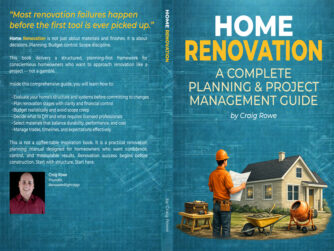
Turning all of those insights into a clear framework eventually became the Home Renovation book, your complete planning and home renovation project management guide focused on understanding the anatomy of your home before planning your home renovation.
If this article helped you see planning differently, there’s more structure freely available on this site, or when you buy our book or by signing up to the RenovateRight.app whenever you’re ready.