


If you’re starting your first-time home renovation, uncertainty is normal.

Even confident, capable people feel overwhelmed at this stage—not because they’re unprepared, but because renovations don’t behave like other projects.
Most advice skips the part first-time renovators actually struggle with:
how decisions stack, why confidence comes and goes, and what really causes things to unravel.
This article explains what no one clearly tells you—and why feeling unsure doesn’t mean you’re doing it wrong.
Why First-Time Home Renovation Projects Feel So Hard
A first home renovation combines three difficult things:
- Large financial decisions
- Long timelines
- Permanent consequences
All without a clear roadmap.

Unlike buying a car or booking travel, renovations:
- Don’t have fixed prices
- Don’t have fixed timelines
- Don’t reveal their complexity upfront
So when first-time homeowners feel lost, it’s not a lack of effort—it’s a lack of context.
What No One Explains Before You Start
1. You’re Not Just Renovating—You’re Managing Decisions
Most people think first-time home renovations are about construction.
In reality, they’re about decision timing.
Every renovation decision affects:
- Cost
- Schedule
- What becomes difficult to change later

First-time home renovation projects feel overwhelming because many decisions arrive before you feel qualified to make them.
That discomfort is normal—and expected.
2. Research Doesn’t Equal Readiness
First-time renovators often do a lot of research.
But reading blogs, watching videos, and scrolling for inspiration doesn’t automatically prepare you for:
- Trade-offs
- Sequencing
- Lock-in points
This is why people can feel “informed” and still unsure.
The gap isn’t information—it’s structure.

3. Confidence Comes and Goes (That’s Not Failure)
Many first-time homeowners experience this cycle:
- Early excitement
- Rising doubt
- A brief sense of clarity
- Then overwhelm again
This isn’t indecision.
It’s what happens when new information arrives after earlier decisions were made.
Understanding this cycle helps you:
- Pause instead of panic
- Ask better questions
- Avoid rushed changes
The Biggest First-Time Renovation Mistake (That Almost Everyone Makes)

Trying to make every decision feel final too early.
First-time home renovators often believe:
“If I don’t lock this in now, I’ll lose control.”
But the opposite is usually true.
Good renovation planning:
- Locks foundational decisions early
- Leaves detail decisions flexible
- Avoids forcing certainty where it isn’t needed yet
This alone prevents many renovation mistakes.
A Simpler Way to Approach Your First Renovation

You don’t need to feel confident about everything.
You need clarity about what matters now.
Here’s a practical mindset shift that helps first-time homeowners:
Step 1: Focus on Outcomes First

Before choosing finishes or layouts, be clear on:
- How you want the space to function
- What problems the renovation must solve
- What would make daily life easier
This gives you an anchor when decisions get noisy.
Step 2: Understand What’s Hard to Change Later
Some decisions are easy to undo.
Others aren’t.
First-time home renovation projects become stressful when homeowners don’t know the difference.
Hard-to-change items often include:
- Structural changes
- Services locations
- Room proportions

Knowing this helps you slow down where it matters.
Step 3: Expect Unknowns (Without Letting Them Control You)
Every first-time home renovation has its surprises.
Planning isn’t about eliminating them—it’s about:
- Allowing for them
- Not letting them derail everything
When you expect uncertainty, it loses its power.

If You’re Feeling Overwhelmed Right Now
This is important to hear:
Feeling overwhelmed doesn’t mean you’re failing at your first renovation.
It usually means:
- You’re early in the learning curve
- You care about making good decisions
- You haven’t been shown a clear framework yet
Once decisions are sequenced properly, the noise quiets down.
Why First-Time Renovators Often Do Better Than They Think

Interestingly, first-time homeowners often:
- Ask better questions
- Notice problems earlier
- Are more open to structure
Once they stop expecting instant confidence, progress accelerates.
Renovation confidence isn’t a personality trait—it’s a by-product of clarity.
This Is Learnable (And You’re Not Behind)

No one starts a first home renovation knowing how everything works.
The goal isn’t to “get it perfect”—it’s to:
- Reduce avoidable mistakes
- Make informed trade-offs
- Stay in control as the project unfolds
With the right approach, a first renovation becomes a foundation—not a regret.
A Quiet Next Step (If This Helped)
Over time, I realized that first-time renovators weren’t missing motivation—they were missing a clear way to think about renovation decisions.
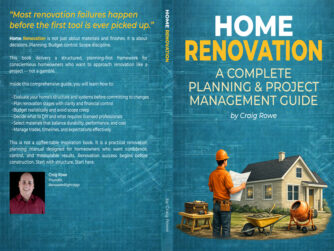
Turning that thinking into simple frameworks eventually became our book titled, Turning all of those insights into a clear framework eventually became the Home Renovation book, your complete planning and home renovation project management guide focused on understanding the anatomy of your home before planning your home renovation.
If this article helped you see planning differently, there’s more structure freely available on this site, or when you buy our book or by signing up to the RenovateRight.app whenever you’re ready.